The method
A.R.C.™ — Awareness, Regulation, Choice.
Three moves, in an order that cannot be swapped. You cannot regulate what you have not noticed, and you cannot decide well from a body that is still braced.
Why three levels, not one
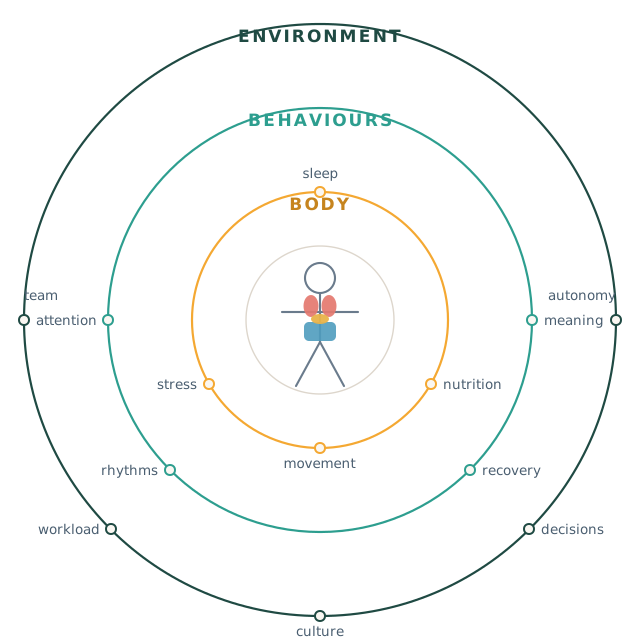
The body sits at the centre — stress, sleep, nutrition, movement. Around it, behaviours: rhythms, relationships, meaning. Around that, the environment: work, decisions, culture, family.
Acting on one ring while ignoring the others simply asks the body to compensate a little more. It will, until it does not. Most interventions work on exactly one ring, which is why their effects fade at about week six.
The three moves
What actually happens in each.
A
Awareness — The Reset
You cannot see your own load from inside it, so awareness starts with a reset: bring the system down, then take the baseline from that state. Twenty minutes makes visible what until now was discussed blind — where the energy goes, which demands are constant, which recovery is real and which is nominal.
Lived experience is treated as data, not as impression — which also means it is written down, compared, and revisited.
R
Regulation — Mind the Gap
Restore physiological margin. Paced breathing, short recovery, transition hygiene between tasks, physiological preparation before a difficult conversation.
Tested, not prescribed: each practice runs for twenty-one days with one light indicator and a stop condition, so you find out whether it works for you rather than whether it works on average.
C
Choice — Choose your destination
Choose a direction, then a considered response in service of it, rather than reacting automatically — at the level of the person, the team and the organisation.
A decision is laid out as facts, assumptions, unknowns, constraints, available options, and the next reversible experiment. Most bad decisions under pressure are assumptions wearing the clothes of facts.
Where the proof stops
What this is built on, and what it is not.
Allostasis — the idea that the body regulates by anticipating demand rather than correcting error after the fact — is a well-specified and well-supported theory of physiological regulation. It genuinely reframes stress from reactive damage to anticipatory budgeting.
What it does not give anyone is a number for how much demand a given person can take. There is no validated physiological measure of workload capacity in a knowledge worker: not allostatic load, not heart rate variability, not a cortisol slope, not a wearable readiness score. Every one of them fails at the individual level.
So A.R.C.™ measures what can honestly be measured — perceived energy, recovery, control, concentration, adoption of practices, decisions actually taken — and treats the physiology as the reason those things move, not as the scoreboard.
Evidence: the regulation theory is solid; the individual measurement is not
In practice
Two ways to run it.
With a team
As the spine of the six-week Human Adaptation Pilot™, or as a standalone sequence when the team already knows what is wrong and needs to move rather than measure.
With one person
As three named steps — The Reset, Mind the Gap, Choose — taken in order, at the pace one life allows.
Next step
Three pilot teams this year.
Twenty-five minutes to check whether this format answers a real problem at your organisation. If it doesn’t, I’ll say so.